Examining the Brief & Initial Ideas
- Mikey Owen
- Jan 22, 2023
- 11 min read

Updated: Jan 23, 2023
Having now finished my Data Capture assignments for the year, I've moved onto the Visual Effects course Module. During this module I'll have two assignments to complete, with the brief for the first set of coursework now available.
As I've done with previous assignments, I'd like to breakdown the brief I've been provided so that I can establish exactly what is expected from me for this coursework and begin brainstorming some ideas.
I've included a download of the brief below for your reference:
General Overview
This coursework will require me to use a variety of software packages (3 minimum) to create an undetermined amount of visual effects for a short animation. This animation will be built around an Unreal Engine 5 environment created using existing assets.
Throughout the progression of this assignment, I will need to make a note of the pros and cons of my chosen VFX software packages. This way I'll be able to make an informed decision around which would be the most suitable for my chosen effects for the final deliverable.
The brief is split into 3 sections: pre-production, production and post-production. It therefore makes sense to breakdown this post into the same categories in order to work out a structured plan for how to see this assignment through to completion.
Pre-Production
The pre-production section of the brief lists tasks that I will need to complete before moving onto the next section. They're fairly straight forward, so I've listed them below, along with a small notation around how I will aim to fulfill each requirement:
Research and Visual Development - This will require me to establish what my environment will be in terms of locale, as well as decide on the visual effects I will be using and what software options I'll be creating them in. From there I'll need to research into the 'look' of the effects and examples of similar environments from which to draw inspiration from, plus the initial pros and cons of others online regarding the software packages available to me. This research can then be compiled and used to influence a decision around the final aesthetics of my environment, effects and what I'll be creating them in.
Develop 3D Layout - This is fairly straight forward. Once I've completed my research and have a good idea of how I want my environment to look, I need to actually develop and create the 3D layout of the scene.
Develop Suitable Lighting Scenarios - This will go hand in hand with the above, but specifically affects the lighting. I'll need to ensure my scene is well lit, paying particular attention to the areas of the environment which will house the effects, especially given that they will be the main focus of this coursework. I'll need to experiment with multiple lighting solutions; like broad daylight, nighttime, volumetrics to emphasize certain aspects (like god-rays, or the light shining directly onto the sword of my previous Data Capture assignment for example).
Pre-visualisation of Proposed Shots and VFX - This will involve running a camera through my scene to create a rough 'pre-viz' of my final animation deliverable. It's here I'll be able to establish things like final camera angles and movements, as well as shot timing. I'll also be able to ensure that my placement for the visual effects translates well into an animation in terms of cinematography. It's here I'll really nail down the flow of my animation and staging of the effects before proceeding into production.
The pre-production of this assignment is fairly straightforward and nothing I haven't already applied during previous courseworks. The only thing to note here is that I'll have to make decisions very early around what my environment and effects will be, so the research section will be absolutely crucial to avoid potential headaches further down the road!
Production
The production section makes up the bread and butter of what I'll need to do with this assignment. This will involve me actually creating the final assets and deliverables, as well as clearly stating my findings from my previous research into VFX software packages. As with the previous section, I've broken down the sections of the brief into their respective headings along with a brief notation on what each means and what I'll do to achieve them:
Create Environment - This is self explanatory. Once I've completed the pre-visualisation, I'll move onto replacing the 3D block out with the final Unreal assets which make up my final environment.
Create Appropriate VFX Elements - This is where the majority of my focus will lie. After selecting the VFX software packages I'll be experimenting with, it's here I will work to create my final effects in each of them, comparing the pros and cons of each before establishing which is the best for my chosen effects.
Implement VFX Elements - Once I've completed the above, it's here I will be adding the effects into my final environment to complete the groundwork for my final animation.
Render Animation - Here is where I will render out my final deliverable. I'll need to explore the best render settings for the task at hand including: resolution and frame rate, additional camera traits such as aperture and lens type etc, and the format in which it will be produced.
The production section is all quite straightforward. It's very much the natural progression following my pre-production phase. I'm looking forward to reaching this point and seeing how my final animation looks! But before I can submit the assignment, there is still the matter of post-production which I've detailed below.
Post-Production
One final section remains of the brief, but arguably this will be the most important as it highlights the importance of really breathing life into a cinematic. It's here I'll be heightening certain aspects of my final animation to really enhance it above any beyond what's displayed within the engine itself. As before, I've broken down the requirements of this section below with notations around what each is and how I will achieve them:
Colour Grading - This is of course something I've experimented with in the past, but this will be my first time using it as an actual requirement to an assignment. The issue with the in-engine renders is that no matter how much tinkering you do with lighting/colour, it can still sometimes appear washed out. Having the facility to alter the colour correction, saturation, exposure etc in post-production will allow me to enhance my visuals far beyond what I could achieve in Unreal.
Add Audio as Appropriate - This is exactly how it sounds. I will need to add audio to my final animation (if it's applicable to do so). This entirely depends on the environment and effects I use. For example: if I create a forest where it's raining, I'll need to add the sound of the wind rustling through the trees, the sound of the water hitting the leaves, perhaps subtle thunder rumbling in the distance etc. I'm a firm believer in audio being just as important as the visuals for cinematography, so I'll be sure to channel this into the audio production of my final animation.
Create a Breakdown Using Separate Render Layers/Elements From Your Unreal Scene - Now this is interesting, as I've used render elements/layers when creating final animations in software like Autodesk 3DS Max, but never in Unreal Engine. I'm sure it's a fairly standard thing to do and won't be too hard to achieve, but I'll need to look into this beforehand so that I know exactly how to produce this breakdown.
That brings us to the end of the assignment requirements! It all seems fairly straightforward, and I'm very excited to get started. There's a level of freedom to this coursework which I find incredibly appealing. There's no preset theme when it comes to environment and effect choice, and even the software options for the VFX are completely in my court to choose from! There are however a couple more things to mention before proceeding to pre-production which I've detailed in the next section.
The Deliverables
Now while I've mentioned above that one of the deliverables for this assignment is of course my final animation, the brief does mention a few more items I'll need to prepare for submission. I've therefore decided to list these all here in this section as an easy to locate reference point for me when I come to submitting the assignment:
The Final Animation - Simply put, this will be the final animation I create based on the sections I've listed above.
Pre-Viz Animation - This will actually be created during the pre-production phase of this assignment, but it is noted on the brief as being a submission requirement. I therefore need to remember to include this video as a separate file submitted with the animation, rather than simply adding it onto a post here.
Presentation - This is the submission criteria that resulted in the creation of this section. The brief mentions a presentation will be required to demonstrate a technical and creative understanding of the VFX software packages during a presentation. This means I will need to prepare a PowerPoint that clearly shows my findings when experimenting with my different software choices during this assignment. Further conversations regarding the presentation with my tutor also clarified that this presentation needs to cover "planning, workflow, final outcome and evaluation" or Research, Planning, Methodology/Workflow, Software Comparison and Evaluation. This is essentially going to be the entirety of these blog posts related to this assignment summarized into a PowerPoint presentation overview of the course as a whole.
Initial Ideas
Now that I've finished examining the brief, I wanted to take a moment to jot down some initial ideas I've had for the environments, effects & software options.
Environments
Graveyard - I actually began work on a small personal project for Halloween last year where I constructed a haunted graveyard scene. The project is incomplete, but it was certainly a fun environment to make! I could potentially expand upon this for this assignment.
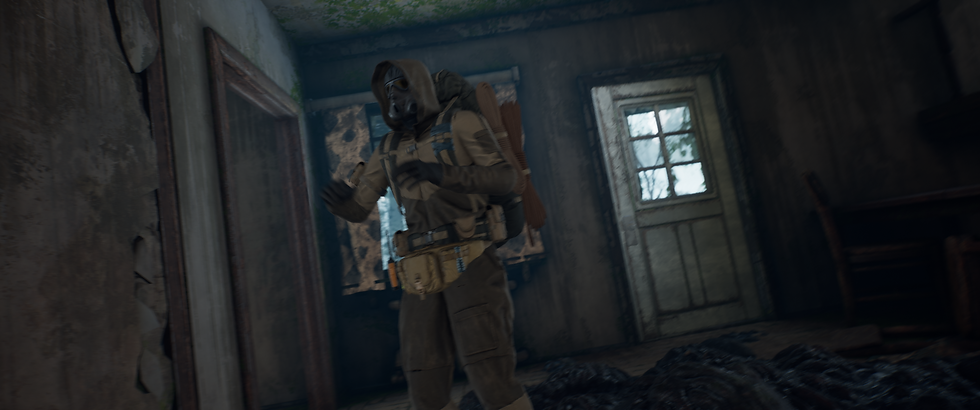
Post-Apocalyptic City/Town - I've recently been replaying a video game called The Last of Us, which features America 20 years after an apocalypse has wiped out the population. I was always fascinated with the environment design used by the development studio Naughty Dog for this title. It's a hauntingly beautiful depiction of American cities being slowly reclaimed by nature. Vines crawling over brickwork, bushes growing over roads, mixed with the decaying foundations of once pristine skyscrapers and businesses. This could be an interesting environment to make!
Gothic/Sci-Fi Architecture - Another video game I've spending a lot of time on recently is Warhammer 40,000 Darktide. This is set in a grim future on a hive-world, where all the buildings are distinctly gothic/victorian, but with a mix of science fiction flair rooting them in the future. I've played a lot of titles and watched a lot of movies with a similar aesthetic and I've always appreciated the unique beauty of these landscapes.
Sci-Fi Horror Environment - Yet another video game I've been enjoying (are you noticing a trend?) is a science fiction horror title called Dead Space. The game is set for a remake releasing in the next week, and I've been incredibly excited to play it given my love for the original. This video game was actually one which has led me down the road of studying CGI, and I think it would be wonderful to try and replicate the spooky interiors of the USG Ishimura (the ship where the game takes place). It's a mining vessel, so fully industrial, but with sci-fi elements littering the environment to offer some additional story-telling. The lack of lighting would also serve to heighten any visual effects that I could add such as flames, sparks, electricity crackling etc.
Effects
Fire & Smoke - The bread and butter of visual effects I've produced in the past. Fire and Smoke seems simplistic on paper, but my past experience with it has shown just how important it is to get it 'looking right'. It would be quite easy to make a fire effect, but having it look realistic via things like heat distortion, light flicker, ember scattering etc. would be a very interesting topic of research!
Mist/Fog/General Volumetrics - This is another effect I have some experience with, but I feel I have yet to utilize it to it's full potential. Volumetrics really go such a long way with enhancing a scene, be it a subtle mist flowing over the top of a lake, a fog causing the light between trees to shine distinct rays down onto a forest floor, there's a lot of potential here.
Rain/Snow/Sandstorm (Weather Effects) - I used a pre-made rain/lighting effect for my final project last year which really enhanced the overall visuals, and I'd love to experiment more with this here. The effect I used was relatively basic, simply dropping small water particles in front of the screen, but the sizes were too consistent and the particles too 'bright' for a night scene. There's a lot more I could have done to make this more realistic, and this could be a great excuse to develop this skill set. As well as rain of course, there's snow that I could attempt to implement, sand/dust storms, hail, plenty of variety all with the same basic principles!
Water - This is something I was really disappointed to omit from my last Data Capture assignment. Water effects really go such a long way for bringing life to a scene. Adding a small stream, a raging ocean, a waterfall etc is great for secondary movement to really sell an environment. I think even at this early stage that this is something I'd really like to implement, regardless of my environment choice.
Wind - Now this technically could fall under weather effects, but I felt it deserved it's own little section here. I've used plenty of foliage packages in the past, but the most recent ones I obtained for my Data Capture assignment were far beyond those I'd used previously in terms of realism. It took me a while to establish why, and it boiled down to simply how the creator had them blow in the wind even though they were static meshes. This effect, no matter how small, brings the foliage to life and really enhances the visuals of a scene.
Destruction - Possibly the most complicated effect on this list is a destruction simulation. This would, in principle, require a particle system of sorts for an explosion, along with the timed destruction of a mesh and scattering of rigid bodies throughout the scene. I'll admit the process intrigues me, but perhaps I'll save this area of study for a later assignment, as it's complexity concerns me that I would have to use this and only this effect for my final deliverable.
Software Options
Niagara - This is Unreal Engine's built in visual effects facility. I've used it in the past to make water and fire particles, but never really 'deep-dived' into it's full capabilities. This would be an obvious choice given that my environment will be created within Unreal Engine. The ability to then construct the visual effects there too would avoid any need for asset importing, and allow me to tailor them to my environment there and then.
Embergen - This software only recently came to my attention thanks to the advice of another student. It's a comprehensive fluid system which would work wonderfully for the majority of the effects I've listed above. It's an expensive option, but thankfully offers a 10 day free trial which should give me plenty of time to conduct the experiments I need to weigh up it's pros and cons.
Cinema 4D - This is a modelling and effects software from the producer Maxon which I've used in previous assignments. My experience with it is quite limited, but it comes highly recommended by one of my tutors! I'll need to conduct some additional research to see what exactly is possible within the software, but it's certainly one to keep on my radar given how easy it will be to access it within the college.
Houdini - This software is honestly quite daunting. I've always been fascinated with the effects people have been able to create within the software, but I've heard it's not very user friendly. Off the bat I know that a basic knowledge of coding and programming is required before even beginning to construct an effect, but it's also one of the most used options within the industry.
Autodesk Maya - This software requires no explanation really. It's my go to software for 3D modelling, but brief research into options revealed it does have the capacity for visual effects. Given how much I've used Maya in the past this would be an obvious choice for this assignment. However, like with Cinema 4D, because I've not used it in a visual effects capacity before I'll need to conduct some research into how feasible my chosen effects will be to produce here.
Adobe After Effects - Now this one is kind of an outlier, as it would require me to create the effects after rendering the animation in the post-production phase. I've used After Effects before for previous assignments to enhance them, like colour correction and exposure adjustments, but never for the sole origin of visual effects. This will also require some additional research, but if the effects are possible this could be a really good option for me!
That brings us to the end of my brainstorming phase. It's certainly given me a lot to think about in terms of the options available to me, and I'll be sure to give my final decision some serious thought over the next few days. Then I can move onto the next post where I'll cement my final ideas for the environment, chosen effects, software packages and begin my pre-production phase.


Comments